Benefits of Cow Breeders What Does Beef Do to Your Body
- Introduction
- Importance of Body Condition Scoring
- How to Trunk Condition Score
- When to Evaluate Torso Condition
- Body Condition Score and Calving Season
- Increasing Body Condition Score from Calving to Breeding
- Supplementing Feeding Based on Trunk Condition Score
- Extended Breeding Flavour
- Salvaging the Breeding Season
- Management Factors Affecting Torso Condition Score
- Summary
- Literature Cited
Introduction
Reproduction is the most of import factor in determining profitability in a cow calf enterprise. To maintain a calving interval of 365 days, a moo-cow must re-brood in 80 to 85 days afterwards calving. Many cows in Georgia need a college level of condition at calving and breeding to improve reproductive performance. Poor reproductive functioning is directly linked to the pct of body fat in beef cows. Torso condition scoring (BCS) is an like shooting fish in a barrel and economical way to evaluate the body fat percentage of a cow. Cows can then be sorted and fed according to nutritional needs. Trunk condition scoring tin be an effective tool for cattle producers who cannot weigh cattle, and it may be an even better measurement of cow condition and reproductive performance than weight. Most studies evidence that torso condition decreases at a faster charge per unit than weight loss. Therefore, trunk condition scoring can estimate the probability of re-convenance.
Beef cattle have nutrient requirements in priority society for body maintenance, fetal evolution, lactation, growth and breeding. The food intake is distributed in the body of the cow to fill these nutrient requirements. Every bit each requirement is filled, the available food is shifted to the side by side lower priority. The contrary shift is also obvious in beefiness cows. As nutrient requirements exceed intake, nutrients are shifted from the lower priority requirements to be sure that higher priority requirements are filled. Beef cattle store backlog nutrients as torso fat. The fat stores are mobilized when the nutrient demands exceed the available intake. In times of severe food restriction, muscle tissue is mobilized one time fatty and other nutrient stores have been depleted. Researchers have adamant that a sure amount of trunk fatty is required for the reproductive system to function. Inadequate nutrition is most often the cause of poor reproductive performance. Developing a nutrition programme is easier and more cost constructive when all cows on the farm can be managed in a similar manner. This is especially truthful when all cows on a farm are managed in a single herd, which is often the example with pocket-size production units. Calving year-circular volition make it very hard to maintain adequate body condition on all cows at the disquisitional times.
Importance of Body Condition Scoring
Body condition affects both cow and calf performance. Poor body status is associated with reduced income per moo-cow, increased mail service-partum interval, weak calves at birth, low quality and quantity of colostrum, reduced milk production, increased dystocia, and lower weaning weights. Increasing post-partum interval will result in a younger, smaller dogie at weaning the next year and will result in lower incomes if sold at weaning. Weak calves at birth may not go adequate colostrum and are more susceptible to disease, reduced weaning weights, reduced feedlot functioning, and less desirable carcass traits. Enquiry clearly shows that cows in moderate body condition will have a shorter interval from calving to first estrus than cows in thin status. This supports the determination that BCS is one of the most important factors in determining subsequent reproductive operation.
Table 1. Description of trunk status scores (BCS) (one [thin] to 9 [obese])a.
| BCS | % Trunk Fata | Detailed Clarificationb |
| Thin | ||
| 1 | 3.77 | Conspicuously defined os structure of shoulder, ribs, back, hooks and pins easily visible. Little muscle tissue or fatty present. |
| ii | 7.54 | Small amount of muscling in the hindquarters. Fatty is present, but not arable. Space betwixt barbed process is hands seen. |
| 3 | eleven.30 | Fat begins to cover loin, back and foreribs. Upper skeletal structures visible. Spinous process is easily identified. |
| Borderline | ||
| four | xv.07 | Foreribs condign less noticeable. The transverse barbed process tin exist identified by palpation. Fat and muscle tissue non arable, but increasing in fullness. |
| Optimum | ||
| five | eighteen.89 | Ribs are visible only when the brute has been shrunk. Processes not visible. Each side of the tail head is filled, but not mounded. |
| six | 22.61 | Ribs not noticeable to the heart. Muscling in hindquarters plump and total. Fat around tail caput and covering the foreribs. |
| vii | 26.38 | Spinous process tin but be felt with business firm pressure. Fat cover in abundance on either side of tail head. |
| Fat | ||
| viii | xxx.xv | Animal polish and blocky appearance; bone construction difficult to identify. Fatty cover is abundant. |
| 9 | 33.91 | Structures difficult to place. Fat cover is excessive and mobility may be dumb. |
| a (Source: NRC, 2000) b (Adapted from: Herd and Sprott, 1986) | ||
How to Body Condition Score
To properly evaluate body condition for cattle, an observer must be familiar with skeletal structures and with muscle and fat positioning. Although at that place are several methods bachelor to determine trunk limerick, many cattle producers utilise a scoring system that involves ranking cattle on a scale. This manuscript volition focus on the commonly used scale of i to 9, with 1 being emaciated and ix being obese (Whitman, 1975).
Cattlemen can easily discover cattle under pasture conditions to obtain body condition scores. Familiarity with fundamental skeletal structures listed in Figure 1 is required to apply an accurate trunk condition score. A description of each status score is listed in Table 1.
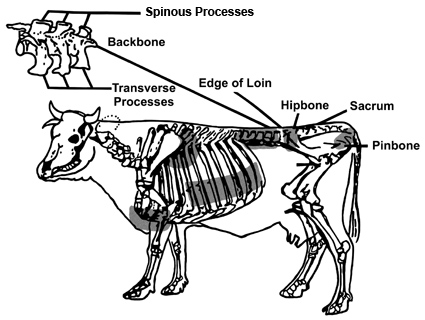
Figure i. Skeletal structures of a cow used to evaluate trunk condition score.
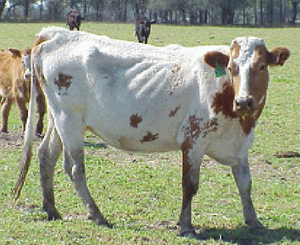 BCS two
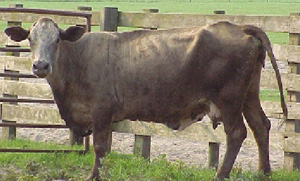 BCS 3
BCS 3
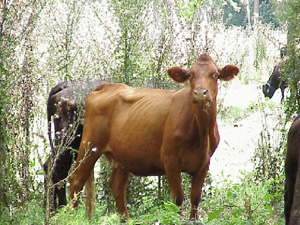 BCS 4
BCS 4
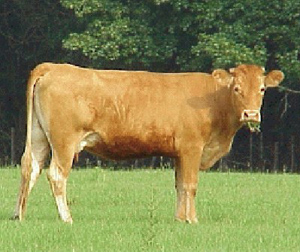 BCS 5
BCS 5
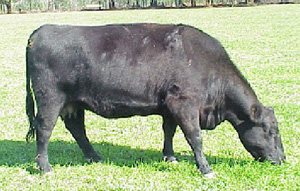 BCS 6
BCS 6
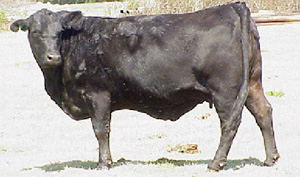 BCS seven
Body condition scoring is a subjective measurement, meaning that one producer may score slightly different than another. The producer can gain experience using body condition scores by identifying cattle into one of three categories: thin (1 to three), deadline (4), optimum (five to seven) or too fat (8 and nine). Over time, as the producer becomes familiar with details of each specific body condition score, these categories can be further broken into actual condition scores. Research reported by the University of Florida (Table two) demonstrates that equally cattle decrease from a trunk condition score of 5 to 4, they may have reduced pregnancy rates by as much as thirty per centum. An additional xxx percent of pregnancies can exist lost when cattle driblet from a 4 to a iii. Cattle that receive a BCS of 5 or beneath may accept reduced pregnancy rates. Although near cattlemen tend to keep cows on the thin side, cattle that are obese (BCS of viii to 9) may as well have reduced pregnancy rates.
Table ii. Relationship of parity and body condition score to pregnancy rate (%)a.
| Body Condition Scoreb at Calving | ||||
| Parity | < 3 | 4 | > 5 | All |
| ane | xx | 53 | 90 | 84 |
| ii | 28 | fifty | 84 | 71 |
| 3 | 23 | 60 | 90 | 85 |
| 4-vii | 48 | 72 | 92 | 87 |
| > 8 | 37 | 67 | 89 | 74 |
| All | 31 | sixty | 89 | 82 |
| a(Rae et al., 1993; Academy of Florida) b(Scale of 1 [thin] to ix [obese]) | ||||
Table three shows the impact of BCS on pregnancy percent, calving interval, dogie functioning, calf cost and income. Cows in a deadline trunk condition (BCS of four) have greatly reduced pregnancy rates, increased calving intervals, lower calf daily gain and greatly reduced yearly income. For example, a cow calving in a BCS of 4 will render an income of approximately $100 less than a cow calving in a BCS of 5. If BCS is taken 90 days prior to calving, the cows in borderline condition can be properly supplemented to achieve a BCS of at least five at calving. In near cases supplemental feed costs will be approximately $25 to $35 for feed that costs $100 to $150 per ton. This is far less money spent on feed than would exist lost if cows were allowed to stay in a BCS of 4. The impacts are even greater for a BCS of three and is a condition that should never happen with any of the cows in the herd.
Table iii. Human relationship of torso condition score to beef cow operation and incomea.
| BCSb | Preg. Charge per unit (%) | Calving Interval (days) | Calf WA (days)c | Calf DG (lb)d | Dogie WW (lb)e | Calf Price $/100f | Income ($/Calf) | Yearly Income $/Cowthou |
| 3 | 43 | 414 | 190 | 1.sixty | 374 | 96 | 359 | 142 |
| iv | 61 | 381 | 223 | 1.75 | 460 | 86 | 396 | 222 |
| v | 86 | 364 | 240 | one.85 | 514 | 81 | 416 | 329 |
| 6 | 93 | 364 | 240 | 1.85 | 514 | 81 | 416 | 356 |
| a(Adapted from Kunkle et al., 1998; UF/IFAS Publication SP-144. b(Body Condition Score; scale of 1 [sparse] to 9 [obese]). c(Weaning Age; 240 days for cows in BCS five and 6 and decreasing as calving interval increases). d(Daily Gain) e(Weaning Weight; calculated equally calf age multiplied by calf proceeds plus nativity weight [lxx lbs]). f(Boilerplate cost for like weight calves during 1991 and 1992). g(Calculated equally income/calf times pregnancy rate times 0.92 [% calves raised of those pregnant]). | ||||||||
When to Evaluate Trunk Condition
Many beef producers are involved in diversified farming operations. These operations may combine cattle with row crops, poultry houses, timber and many other time consuming production practices. Regardless of the combination, additional obligations may limit the amount of time producers tin can spend evaluating torso condition. Still, neglecting to properly detect and record torso condition tin have a substantial affect on overall productivity and profits.
To properly identify cattle that accept increased nutritional needs, producers should evaluate body condition as often as possible, but a minimum of three times (weaning, 90 days pre-calving and breeding) per year is preferred. Cattle that are calving should have plenty torso condition to let for a reduction in body mass due to weight being lost during the parturition procedure and fluids being displaced. Body condition score at calving fourth dimension provides the all-time prediction of re-breeding functioning. Evaluating BCS approximately xc days prior to calving allows sufficient time to adjust the feed ration to ensure cows are in acceptable body status at calving.
Weaning
Evaluating trunk status at weaning tin exist useful to determine which cows or heifers demand the most proceeds prior to calving. Since calves will no longer suckle, lactating cows will exist able to dry off and add needed weight before calving. The time period from weaning to calving has proven to be the easiest and most economical time to add together condition to cattle. Producers who fail to evaluate body condition and adjust the nutritional needs of the cow herd after weaning may have difficulty adding condition later on in the production wheel.
xc days Prior to Calving
Assessing body condition xc days prior to the beginning of the calving flavour may be useful in preventing extended periods of anestrus. This score may exist taken at weaning in herds that delay weaning until calves are 8 to10 months of historic period. However, weaning calves at to the lowest degree xc days prior to the outset of the calving season is recommended. Moo-cow nutritional requirements are greatly lowered when non-lactating and should permit the cow to achieve adequate body condition at calving with minimal supplemental feeding. Diet tin then be adjusted for cattle that receive trunk condition scores of less than five later on this assessment. Although changes in weight tin can be accomplished, have care to forbid excessive weight gain immediately prior to calving. Cows should be fed to calve in a BCS of v to half-dozen and heifers a BCS of six.
Convenance
After undergoing the stress of parturition, cattle will lose body condition. The fourth dimension period from calving to breeding is the virtually difficult in which to amend trunk condition. This is why it is very important to body condition score cows 90 days prior to calving and make ration changes to achieve optimum BCS prior to calving. Approximately 90 percent of cattle in optimum trunk status will resume oestrus cyclic activity 60 days postpartum. Assessing torso status at breeding may offer useful information that may assistance explicate reduced pregnancy rates.
Torso Condition Score and Calving Season
The calving season in Georgia varies widely amid cattle operations, merely most calves are born from September through March. Calving season has a large bear on on phase of the cow's yearly production bicycle in which trunk condition score is most probable to be scarce.
In the southeast, cows calving in the fall months are likely to have adequate body condition score, then the wintertime feeding menses ordinarily begins shortly later the calving flavor begins. Therefore, cows are lactating throughout the winter feeding menstruation. Increased demands of lactation and failing feed quality during the fall months oft causes inadequate body condition past the starting time of the breeding flavour, which begins in early- to mid-wintertime. The majority of producers feed hay every bit the base nutrition during this period. Hay will probable require supplementation and the hay feeding period may last throughout the breeding period for cows calving during the fall. In contrast, cows calving in late winter will be in late gestation and early lactation during the wintertime feeding menstruation. Body condition score at calving will have to be monitored more closely than autumn calving cows as the cows volition be fed hay through virtually of the last trimester. Cows will likely be fed a hay based diet that requires supplementation during the early lactation period. However, supplementation can cease when hay feeding stops and grazing becomes bachelor. Cows should be able to increment trunk condition score when grazing lush jump growth of fescue, ryegrass, or pocket-sized grain pasture.
Increasing Body Condition Score from Calving to Breeding
The easiest and most economical time to better body condition score is from weaning to calving. In situations where cows calve in a less than adequate body condition, weight proceeds must be increased chop-chop post-obit calving to achieve acceptable pregnancy rates at the finish of the breeding season. The most difficult flow to maintain body condition is from calving to breeding. Body condition score and re-breeding rates can exist improved in cows calving in less than a 5 condition score if fed to increase condition prior to the kickoff of the convenance flavour. Mature cows, notwithstanding, will answer to supplementation much improve than commencement dogie heifers. Table 4 illustrates the effects of body condition score at calving and subsequent body weight gain on pregnancy rates of outset calf heifers. Heifers that calved in a body condition score of v or higher up had greater than 90 per centum pregnancy rates when either gaining weight or maintaining weight. In heifers calving in a BCS of less than 5, pregnancy rate was increased from 36 to 67 percentage by increasing daily proceeds from 0.7 to 1.8 pounds per twenty-four hours. Fifty-fifty though increasing daily gains improved pregnancy rates, the 67 pct pregnancy rate is non adequate and was far below both groups calving in a condition score of 5 or greater. This study shows that, for first dogie heifers, torso condition score at calving is the key component to high re-breeding rates.
Table 4. Effects of calving BCS and subsequent weight proceeds on reproductive performance of first calf heifers.a
| Calving BCS | Weight gain, lb/db | Pregnancy % |
| < 5 | 1.eight | 67 |
| < 5 | 0.7 | 36 |
| > 5 | i.0 | 94 |
| > 5 | 0.1 | 91 |
| aAdapted from Bell, et al. 1990 bWeight gain = daily weight gains from calving to the kickoff of the convenance season. | ||
Torso condition score at calving is less disquisitional for mature cows. Certainly, information technology is ideal to take cows in a body condition score of five at calving through breeding. Adequate re-breeding rates, even so, can be achieved in mature cows that calve in borderline (BCS of 4) status if cows are fed to increment trunk condition score to a 5 at the start of the breeding flavour.
A study evaluated the effects of food intake from the 2d trimester through the kickoff of the convenance season. The get-go group was fed to maintain a body status score of v from the 2nd trimester to the first of the breeding season. The 2d group was fed to be a BCS of 4 during the second trimester, and then regain status during the 3rd trimester to a BCS of 5 at calving. The tertiary group was fed to exist in a BCS of 4 from the second trimester through 28 days mail service-calving, and then gain weight to be in a BCS of 5 at the outset of the breeding season. Table five shows the body condition scores and Table six shows the post-calving weight gains and pregnancy rates. All groups were in a BCS of 5 just prior to the starting time of the breeding season as planned. Acceptable pregnancy rates occurred in all groups. Cows that calved in a BCS of 5 to half dozen lost weight from calving to the start of the breeding season; cows that calved in a BCS of 4.8 had to be fed to gain 3.43 lbs per day to increase torso condition to maintain an acceptable re-convenance rate. Such rapid weight gain would require a grain-based or corn silage based nutrition. Cows in a BCS of less than 5 at calving should exist separated from the residuum of the herd and a feeding program designed to increment BCS should begin immediately. The cows that calved in a BCS of 4.eight were only slightly below the desired BCS of 5 and cows calving in a BCS of less than 4 may not have adequate pregnancy rates.
Tabular array 5. Effect of restricted feeding on body condition score of mature cows.a
| Feeding Levelb | |||
| Days from Calving | High-High-High | Low-High-High | Low-Depression-High |
| -95 | 6.0 | 5.three | 5.4 |
| 0 | five.6 | five.five | 4.viii |
| +58 | 5.two | 5.1 | 5.2 |
| aAdapted from Freetly et al., 2000. bHigh-High-High = maintain BCS of 5.5 from weaning to convenance. Low-High-High = decline in BCS in 2nd trimester and regain BCS to a 5 during tertiary trimester. Low-Low-High = decline in BCS during second trimester through 28 days postcalving, then regain BCS to a five at breeding. | |||
Table vi. Effect of restricted feeding on postpartum weight gain and pregnancy rates of mature cows.a
| Feeding Levelb | |||
| Detail | Loftier-High-High | Low-High-Loftier | Low-Depression-High |
| Weight gain, lb/d | -0.46 | -0.64 | 3.43 |
| Pregnancy charge per unit, % | 93 | 92 | 88 |
| aAdapted from Freetly et al., 2000. bHigh-Loftier-High = maintain BCS of 5.5 from weaning to breeding. Low-Loftier-High = reject in BCS in 2nd trimester and regain BCS to a five during third trimester. Depression-Low-High = pass up in BCS during 2nd trimester through 28 days post-calving, and then regain BCS to a 5 at breeding. | |||
Supplemental Feeding Based on Body Condition Score
Grouping past Body Condition Score
A torso status scoring system is much more effective when cows can be sorted and supplemented relative to target trunk condition score. The amount of sorting will depend on the availability of pastures and labor. Ideally, mature cows should be separated into an adequate (≥v condition score) and inadequate BCS group (<5 condition score). In improver, first-calf heifers and developing heifers should remain in separate groups. Condition scores of heifers exercise non vary equally greatly as those of mature cows, and heifers tin usually be fed together.
Some other option is to sort your cow herd into mature cows in condition score of 5 and greater in i group and heifers plus cows in condition score of less than 5 in another grouping. The primary benefit of grouping by torso status is to reduce supplemental feeding costs and implement a more specialized management system for sparse cows.
Determining Needed Level of Supplementation
Body condition scores of cows must be determined prior to the commencement of a supplemental feeding programme. Trunk condition score has a pregnant impact on the requirement for energy but only a pocket-size effect on the poly peptide requirement. Many supplementation programs focus only on supplemental protein and fall brusque of providing enough free energy to maintain an acceptable BCS. Energy rather than protein is ofttimes the most limiting nutrient in Georgia forages.
To increment body condition, the kickoff pace is to decide how many pounds a cow needs to gain to reach the desired BCS. To increase one condition score, a cow needs to gain about 75 pounds. A dry out pregnant cow would need approximately 375 pounds and a lactating cow 575 pounds of TDN (Total digestible nutrients) above maintenance to increase one body status score in a 75-day menses. This would equate to approximately 6.v pounds of corn per solar day for a dry out pregnant cow and x pounds of corn per mean solar day for a lactating cow.
Tables 7 and viii list the requirements for TDN and crude poly peptide for cows and heifers in different trunk condition scores. For instance, a cow that is in body condition score of four at 60 days prior to calving needs to gain about i.25 lb per day to attain a condition score of 5 at calving.
The next step is to determine if the feedstuffs available on the farm will back up this gain. For example, a nutrient analyses indicated that the hay was 10 pct crude poly peptide and l percent TDN. Assume that a dry cow will consume near 2.0 percent of trunk weight per day and a lactating cow will consume about 2.25 percent of her body weight per day in dry feed. Therefore, the dry out cow in a torso condition of iv volition consume near 24 lbs of hay per 24-hour interval. The 24 pounds of hay at fifty percent of TDN volition yield 12 pounds of TDN. From the data in Table vii, the cow needs 16 pounds of TDN. Therefore, the moo-cow must be supplemented with 4 pounds of TDN per mean solar day. In that location are many grains, byproduct feeds and supplements that will work. The primary factor in determining which supplement to apply is price. The crude protein supplied by the 24 pounds of hay is about two.iv pounds per twenty-four hours, and the moo-cow requires 2.1 pounds per day. Therefore, the supplemental feed does non have to be loftier in crude poly peptide, and high energy, low rough protein feeds such as corn can exist used. In nigh cases, hay will not supply sufficient nutrients to increase torso condition score. Figurer ration balancing programs are bachelor through Cooperative Extension. These programs can speedily balance diets for poly peptide and energy to attain the desired body condition score, but an accurate assay of feeds is needed to accurately balance a nutrition.
Table seven. Daily requirements of TDN and rough protein for a 1,200 lb mature moo-cow.
| Phase of product | lbs of TDN | lbs of Rough Protein | ||
|---|---|---|---|---|
| BCS 4 | BCS 5 | BCS 4 | BCS v | |
| Late gestation | 16.0 | 12.7 | 2.ane | i.7 |
| Early on lactation | eighteen.4 | fifteen.0 | two.ix | 2.6 |
| Adapted from NRC, 1996. | ||||
Table 8. Daily requirements of TDN and crude protein for a 1,000 lb first-dogie heifer.
| Stage of production | lbs of TDN | lbs of Crude Poly peptide | ||
|---|---|---|---|---|
| BCS 4 | BCS 5 | BCS 4 | BCS five | |
| Tardily gestation | 15.4 | 12.eight | 2.0 | 1.7 |
| Early on lactation | 18.iv | fifteen.2 | 2.8 | 2.5 |
| Adapted from NRC, 1996. | ||||
Choosing a Supplement
A wide range of supplements tin supplement existing f orage to maintain or increase body condition score. Nutrients may include free energy, poly peptide, minerals and vitamins. Minerals and vitamins are not altered significantly past BCS, so supplements will exist chosen based on their free energy and protein concentration. Factors impacting type of supplement used will exist nutrient content of forage, lactation condition, desired daily proceeds, toll of supplement, and availability of supplement. The just fashion to get an accurate cess of hay quality is to have the forage analyzed for food content. Type of supplement will and then be dictated past how much protein and energy supplementation is required per mean solar day to achieve the desired performance level. If free energy is the only limiting nutrient, nigh any supplement volition work. High free energy supplements such equally corn grain will commonly be the nearly economical. If both energy and protein are required, then a past-product with a high level of protein such as corn gluten feed, distillers grains or whole cottonseed tin can exist used. Case supplementation protocols are shown for lactating cows in Tabular array 9 and for dry meaning cows in Table x.
Table ix. Hay quality and supplem entation required for 1,200 lb lactating moo-cow producing xv lbs of milk/mean solar day. (Recommended feeding amounts assumes moo-cow is in a BCS of >= 5.
| Quality of hay | Crude Protien % | TDN % | Supplement Required. |
|---|---|---|---|
| Excellent | 11.two and over | 58 and over | None |
| Good | 9.5 to 11.1 | 53 to 58 | 4 lbs corn gluten feed or iii lbs corn and 1 lb soybean meal or 4.5 lbs of 20% crude protein cubes or 4 lbs of whole cottonseed |
| Fair to good | 8.2 to 9.5 | 50 to 53 | 6 lbs of corn gluten feed or 5 lbs of corn and 1.5 lbs soybean m eal or 7 lbs of 20% rough protein cubes or 6 lbs of whole cottonseed |
| Poor to off-white | vii.3 to 8.two | 50 and under | 8 lbs of corn gluten feed or half-dozen lbs of corn and 2 lbs soybean yard eal or viii.5 lbs of 20% crude poly peptide cubes or 6 lbs of cottonseed and ii lbs of corn |
| Very poor | under vii.iii | 49 and under | 9 lbs of corn gluten feed or half-dozen.5 lbs of corn and ii.5 lbs soybean thou eal or ten lbs of 20% range cube or seven lbs of whole cottonseed and 2 lbs of corn gluten feed |
Tabular array x. Hay quality and supplementation required for i,200 lb dry pregnant. (Recommended feeding amounts assumes cow is in a BCS of >= 5.
| Quality of hay | Crude Protien % | TDN % | Supplement Required. |
|---|---|---|---|
| Excellent | 11.2 and over | 56 and over | None |
| Good | 9.five to xi.1 | 53 to 56 | None |
| Off-white to good | eight.2 to nine.5 | 50 to 53 | 3 lbs of corn gluten feed or iii lbs of corn or 3.five lbs of 20% crude protein cubes or 3 lbs of whole cottonseed |
| Poor to fair | 7.3 to 8.2 | 50 and under | 4.5 lbs of corn gluten feed or iv lbs of corn and 0.5 lb soybean chiliad eal or 5 lbs of 20% crude protein cubes or 4 lbs of cottonseed |
| Very poor | nether 7.3 | 49 and under | 6 lbs of corn gluten feed or 5 lbs of corn and one.0 lb soybean m eal or 6.five lbs of twenty% crude poly peptide cubes or v.5 lbs of whole cottonseed |
By-production feeds are an increasing source of winter supplementation in the southeast. They are often priced competitively with corn and oilseed meals. In addition, some by-product feeds take a moderate protein content, which reduces feed costs compared with a traditional corn-soybean meal mixture or a commercial protein supplement. In improver, by-product feeds such every bit soybean hulls, wheat middlings, corn gluten feed, distillers grains and citrus pulp are low in starch but high in digestible fiber. These by-products can be fed at higher levels than corn before fodder intake and digestibility is depressed. The high starch content of corn causes a negative consequence on digestion when supplementation level exceeds approximately 0.5 percent of body weight and worsens as supplementation level is increased. When high levels of supplement are needed, a low starch by-product feed is recommended.
Cocky-controlled supplements such equally molasses lick tanks and hard compressed molasses or high poly peptide blocks are pop choices because of low labor requirements. These supplements are designed to be primarily protein supplements. In most situations, cows require both supplemental poly peptide and energy. Frequently, the hard block supplements cannot exist consumed in great enough amounts to provide the desired level of energy. These supplements get less desirable as hay quality declines and supplement needs are increased. Additional free energy may need to be supplemented when these products are fed. The liquid molasses-based supplements can exist consumed at higher levels and will more closely friction match requirements for free energy than hard pressed blocks. Consuming too much molasses, however, can cause a decrease in forage digestibility and intake.
Grazing cows on winter annual pastures is a popular choice for many producers in Georgia. Wintertime annual pastures are high quality, and they provide actress energy and protein for lactating cows while decreasing the feeding of hay. Winter pasture alone is as well high quality for virtually cows; limit-grazing provides the most efficient use of these high quality forages for beef cows.
Winter pastures comprise approximately 25 percent rough protein and 75 pct TDN and tin can meet supplemental protein and free energy needs. The most pop method of grazing cows on winter pasture is limit-grazing a few hours every solar day. You can get satisfactory results, yet, by grazing as lilliputian as every other day or merely two or iii days per calendar week. Research has shown that grazing lactating cows for seven hours per day for either two or three days per week is as constructive in maintaining cow status equally grazing every 24-hour interval and is particularly constructive for cows calving in the fall.
Economics of Supplemental Feeding
Providing supplemental feed to amend BCS for acceptable pregnancy rates is an economical practice. In almost every herd, beginning-calf heifers are the near difficult grouping to go re-bred. Information technology has been estimated that a heifer that does not re-breed subsequently calving costs the producer from $200 to $500. Research has shown that offset-dogie heifers having a BCS of four at breeding time will have pregnancy rates of approximately 50 percent, and outset-calf heifers having a BCS of 5 at breeding time volition take about a 90 percent pregnancy rate.
For case, a producer has a group of 10 heifers in a BCS of 5 at calving. If heifers are merely fed poor qua- lity hay (eight% CP and 50% TDN) from calving to breed- ing, a decrease of one condition score is likely. The recommendation in Table 10 suggests that feeding eight pounds of corn gluten feed a day volition maintain a BCS of 5. This would cost approximately $0.48 per day or $28.80 for the entire feeding flow if the gluten feed was priced at $100 per ton. The producer can provide supplemental feed to these 10 heifers for sixty days prior to the offset of the convenance season to maintain a BCS of 5 at breeding fourth dimension.
In this instance, we would look four more heifers to become pregnant compared with no supplemental feeding. This would save $800, assuming a total of $200 for each additional heifer bred. Using an example of corn gluten feed at $100/ton, the producer tin can buy eight tons of corn gluten feed with the $800 and notwithstanding break even on additional feed costs. Nonetheless, it would simply have approximately ii.5 tons of corn gluten feed to achieve this goal. This does not include additional benefits of higher weaning weights and earlier calving cows the adjacent year.
Clearly, it is economical to improve body condition of lactating cows rather than reduce feed costs and take reduced pregnancy rates. Supplemental feeding must brainstorm shortly after calving, nonetheless. Waiting until the breeding season starts is besides late. Poor preg- nancy rates and an extended re-breeding period is certain.
Extended Breeding Season
Some producers believe that increasing the length of the breeding season will result in high re-breeding rates of cows in poor torso condition. Cows, however, volition non re-breed at acceptable levels as long as they are in poor condition. This is conspicuously illustrated in Table 11. Cows that were in a BCS of iv or less had only 58 percent pregnancy rate, despite 150 days of exposure to the balderdash. Cows that practice become meaning at the end of an extended breeding season will wean smaller calves and volition be unlikely to re-brood the following year.
Table 11. Effect of trunk condition score during the breeding flavor on pregnancy, in terms of trunk status during convenance.
| Item | 4 or less | five |
|---|---|---|
| Percent meaning after 150 days | 58 | 85 |
| aAdjusted from Sprott, 1985. | ||
Salvaging the Breeding Season
When cows are in status scores of less than 5 at the start of the convenance season, increasing nutrition will better pregnancy rates but not enough to maintain high pregnancy rates and a yearly calving interval. To achieve high ($xc%) pregnancy rates and maintain a yearly calving interval culling direction strategies will need to exist implemented. The nearly effective management practice is to wean the calf to remove the demands of lactation on the cow. This direction do is oftentimes employed with outset dogie heifers. Nonetheless, it is an effective management tool to increase rebreeding rates in mature cows.
Early Weaning
In about herds, kickoff dogie heifers normally have the lowest body condition at the beginning of the breeding season. These heifers will likely need some cessation of nursing by reduced exposure to the calf or by weaning the calf to achieve high re-breeding rates. Early weaning the calf at the initiation of the convenance season volition atomic number 82 to high re-breeding rates if adequate supplementation is supplied. Removing the demands of lacta- tion greatly reduces energy and poly peptide requirements. Early weaning must be washed by the start of the breeding flavor to improve re-breeding rates. Calves should be a minimum of 30 days erstwhile prior to weaning.
Table 12 compares weights and condition scores of heifers with calves weaned at the first of the breeding season with those with calves weaned at the finish of the breeding flavour. Weight and BCS at the end of the breeding season were greater for heifers with early weaned calves. Most importantly, heifers with calves weaned at the get-go of the breeding flavour had a 90 percent re-breeding rate versus only fifty percentage for heifers that nursed their calf throughout the breeding season.
Another advantage to early weaning is decreased feed costs of the cow. Cows will consume approximately 20 to xxx percent less feed afterward early weaning compared to lactating cows and gain significantly more weight than lactating cows. Inquiry has also shown that TDN requirements are 50 percentage less for a dry first calf heifer to maintain equal status scores as a lactating first calf heifer. This would stand for a substantial reduction in feed costs for fall calving cows, which are fed harvested feeds through much of the lactation period. The improvements in pregnancy rates and reduced feed costs brand early weaning the best selection for cows that are below the desired body condition score at breeding time.
The disadvantage to early weaning is increased feed costs and management of the early weaned dogie. Calves must have access to loftier quality winter almanac pasture or should be fed a high concentrate grain mix in a drylot. Feeding programs that have used wintertime annual pastures plus an energy supplement have been very successful for calves weaned at less than 80 days old. Table thirteen shows daily gains of early weaned calves that grazed ryegrass pasture plus i pct body weight daily of a 16 percent crude protein supplement. Calves were stocked at approximately four calves per acre. Weight gains were similar between the early on and normal weaned calves. The winter pasture plus supple- ment program would work well for most cattle producers in Georgia.
Table 12. Effect of early weaning first calf heifers on weight and body condition score.a
| Item | Beginning of breeding season b | End of breeding season | Weaning c |
|---|---|---|---|
| Normal weaned, wt | 941 | 919 | 982 |
| Early weaned, wtc | 907 | 954 | 1074 |
| Normal weaned, BCS | 3.88 | 4.27 | 4.50 |
| Early weaned, BCS | 3.9 | v.11 | 6.25 |
| aAdapted from Arthington, 2002. | |||
| bInitial weight was nerveless at the get-go of the breeding flavor. | |||
| cFinal weight was collected at weaning. | |||
Tabular array xiii. Upshot of early weaning first dogie heifers on calf weight.a
| Item | Early Weaned | Normal Weaned |
|---|---|---|
| Initial weight, lbb | 200 | 192 |
| Last weight, lbc | 492 | 509 |
| Daily proceeds, lbs | 1.fifty | 1.68 |
| aAdapted from Arthington, 2002. | ||
| bInitial weight was collected at the outset of the breeding season. | ||
| cFinal weight was collected at weaning. | ||
Management Factors Affecting Body Condition Score
Several direction decisions can touch on the trunk condition of the cow herd. Some of these include stocking rate, calving flavor and herd health. Calving season and the duration of the calving season can influence cow body condition. Supplementation must be well planned for cows calving in the autumn and early on wintertime months, every bit most of the calving to re-breeding menstruation will exist on harvested feeds. In add-on, a shorter calving volition allow the producer to feed the herd more efficiently, because all the cows in the herd will be in the aforementioned stage of production.
Year-round calving will cause meaning nether- and over-feeding unless calves are managed as multiple groups. Adjust stocking rates so adequate fodder is available to maintain adequate status during the grazing season. If hay or supplement must exist fed every dry spell, the stocking rate is probably too high.
Treat cattle for internal and external parasites. Georgia is an excellent environment for worms, and the cows should be treated at least one time per year.
Summary
A torso condition score of 5 to six at calving and breeding time will result in acceptable pregnancy rates. Heifers calving in body condition score of less than 5 will take less than optimal reproductive functioning, even when nutrition is greatly increased later calving. Cows are more than responsive to increased nutrition later on calving. Clearly, information technology is more than economical to ameliorate body condition rather than reduce feed costs and have reduced pregnancy rates. Supplemental feeding must brainstorm, even so, shortly afterward calving to better or maintain body condition. Waiting until the breeding season starts is too late to efficiently alter BCS and have an impact on reproductive performance, and poor pregnancy rates will likely result. Early on weaning is a proven management do to maintain loftier re- breeding weights in cows and heifers calving in less than a 5 body status score.
Literature Cited
Arthington, J. D. 2002. Early Weaning – A management alternative for Florida Cattle Producers. University of Florida, IFAS, Florida Coop. Ext. Serv., Creature Science Dept., EDIS Publication AN131.
H. C. Freetly, C. 50. Ferrell, and T. G. Jenkins. Timing of realimentation of mature cows that were feed-restricted during pregnancy influences calf birth weights and growth rates. J. Anim Sci. 2000 78: 2790.
Herd, D.B, and L.R. Sprott. 1986. Torso Condition, Diet and Reproduction of Beef Cows. Texas Agronomical Extension Service. B-1526.
Kunkle, Due west.E., R.S. Sand, and D.O. Rae. 1998. Effects of body condition on productivity in beef cattle. Department of Animal Science, Florida Cooperative Extension Service, UF/IFAS. SP-144.
NRC. 1996. Growth and Trunk Reserves. Food Requirements of Beefiness Cattle. 7th ed. Washington, D.D.: Natl. Acad. Press.
Rae, D.O., W.E. Kunkle, P.J. Chenoweth, R.S. Sand, and T. Tran. 1993. Human relationship of parity and body status score to pregnancy rates in Florida Beefiness Cattle. Theriogenology 39:1143.
Sprott, L.R.Body condition, nutrition, and reproduc- tion of beef cows. Texas Agronomical Extension Service. B-1526.
Condition and Revision History
Published on April 14, 2006
Published on Feb 04, 2009
In Review on Jan 05, 2010
Published with Full Review on Feb 06, 2014
Unpublished/Removed on January 09, 2017
Published with Full Review on Feb 27, 2019
Source: https://extension.uga.edu/publications/detail.html?number=B1308&title=Body%20Condition%20Scoring%20Beef%20Cows
0 Response to "Benefits of Cow Breeders What Does Beef Do to Your Body"
Post a Comment